The moment you press Play, Avia Masters stops waiting for you. A small plane lifts off along a route chosen at random, and from that second the outcome depends on the flight rather than on anything you select.
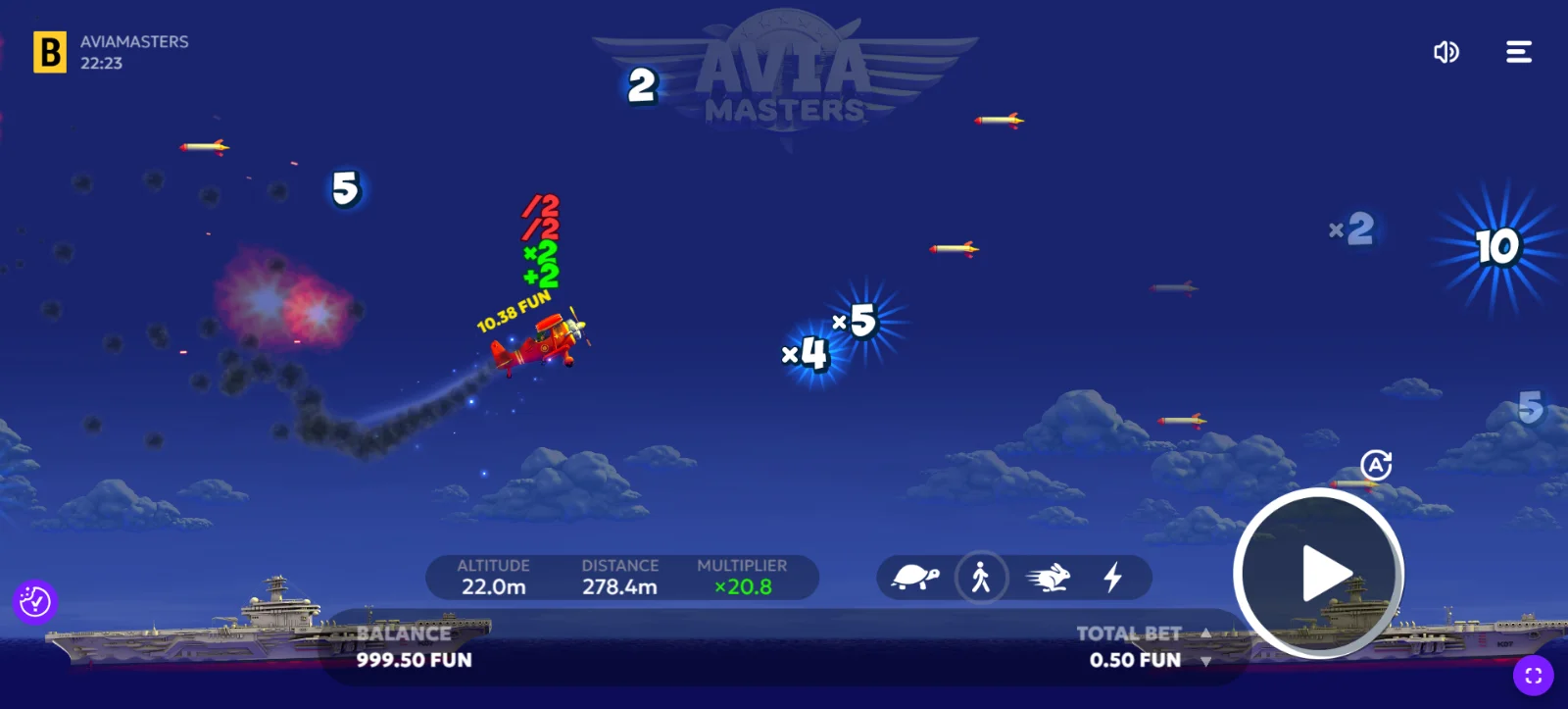
What happens next is easy to follow. Floating just above the aircraft is the round balance, which opens at precisely the amount you staked. Boosts drift into the plane's path and push that figure upward. Rockets chop it in half. Far ahead waits either an aircraft carrier or open sea, and only the carrier pays.
That is the whole stage. Avia Masters has no reels, no paylines and no bonus map, only one aircraft, one number, and one touchdown.
What follows tracks one round, click by click, until its last second, then moves to the controls wrapped around it: speed, autoplay and the progress dashboard. After those come the published figures, the free demo, the path to real-money play and a few habits worth keeping.
Everything is described the way the game actually behaves, without forecasts and without any talk of outwitting chance.
Setting the stake in Avia Masters
A round starts with one decision. Before the plane moves, you determine what this flight is worth, and every boost or rocket afterwards works from that base.
| Step | Detail |
|---|---|
| Choose the stake | Select the amount for the forthcoming round. It becomes the opening round balance, so the entire flight is measured against it. |
| Check the range shown in the game | Minimum and maximum stakes vary by operator, and both appear right inside the game. Rely on those rather than on numbers quoted elsewhere. |
| Press Play | Take-off is immediate, and the stake is committed to that round. |
The range deserves a glance each time you open Avia Masters somewhere new. Two operators can host an identical game and still allow quite different minimums and maximums, so the limits on screen are the ones that apply.
A comfortable stake fits well within the budget you set before logging in. Rounds move fast, and an amount that seems trivial once can weigh heavily after dozens of repetitions. Settling on it away from the screen, not mid-session, makes it far easier to adhere to.
Take-off and the round balance
Once airborne, the screen asks you to follow only a handful of things, and each has a distinct role.
- The route is random from the very start. Earlier rounds leave no trace on it, and no setting reshapes it.
- In Avia Masters, the round balance hovers above the plane. It begins at your stake and rises or falls as the flight progresses.
- This number is separate from your account balance. The two remain apart throughout, and nothing transfers unless the aircraft lands on the carrier.
- Boosts lift the number and the aircraft together, so altitude and value rise in tandem.
- Rockets reverse both, halving the figure while the plane drops.
- Changes appear live. A healthy figure halfway along is a snapshot, not a payout, and it can still shrink before landing.
- Nothing is final until the landing. Several boosts and rockets may cross the route first, and only the number upon arrival matters.
First boosts on the path
Boosts lie scattered across the route, and the plane collects whichever ones it crosses. Eight exist in total, divided into two families.
One family adds. Its members carry a plus sign: +1, +2, +5, +10. The other family multiplies: x2 and x3, then x4 and x5.
Additions nudge the running total upwards. Multipliers scale it. That contrast gives every Avia Masters round its shape. An x3 caught right after take-off acts on a balance still equal to the stake, while that symbol, encountered later on once some additions have landed, has a larger base to scale and moves the figure much further.
Each pickup has a double effect. The number above the aircraft grows, and the plane gains height at that exact moment. Observing both movements together is the quickest way to understand what a boost has just done.
Modest additions matter more than they seem. A series of +1 and +2 pickups looks unremarkable on its own, yet it broadens the foundation for any multipliers still to come.
Multipliers serve a second function too. The game keeps a tally of those collected during the flight, and that tally drives the win pop-ups covered later.
None of this responds to input. You cannot steer towards a boost or swerve around one. The plane keeps its random course, and the pickups are simply whatever that course happens to cross.
When a rocket hits
Rockets serve as the counterweight. They appear along the route just as unpredictably as boosts, and contact with one changes two things simultaneously.
| Before | After |
|---|---|
| The round balance reflects every pickup so far | The figure drops to 50% of its former value |
| The aircraft holds its current height | The aircraft sinks noticeably |
| Earlier boosts have pushed the figure up | Those gains shrink by half along with everything else |
| The flight is still on its random course | Flying continues, so a later boost may still raise the figure |
The second row is easy to overlook. A rocket reduces value and height alike, so a plane cruising high can drop sharply after one contact.
Halving is proportional. A large balance sheds a large amount and a small one sheds little, but the portion removed never varies.
Contact with a rocket keeps the round running. The Avia Masters flight continues, and whatever arrives next, another boost or another rocket, works on the reduced figure. A recovery can happen, but nothing guarantees one, and the game gives no warning before a rocket appears.
Choosing the speed
Avia Masters lets you pick from four flight speeds; speed 2 is what loads by default. Switching is possible mid-round as well as between flights.
The choice concerns pace. Slow play gives you room to watch every pickup and see exactly how it changed the figure. A quicker one squeezes those same events into a shorter span, which appeals to anyone already familiar with the screen who mainly wants the outcome.
Think of speed as a comfort setting. Choosing a faster mode in hope of a kinder landing misreads its purpose, because no setting makes the route any less random.
Pace still has a cost. Quicker flights let more rounds fit into an evening, and each round consumes a stake. A brisk setting can empty a session budget well before the planned finishing time, purely because more flights squeeze in.
Hasty choices often follow hasty play. When a quick rhythm starts tempting you to raise the stake or push past a limit, a slower speed or a short break away from the game buys time to reconsider.
The approach to the carrier
The closing stretch decides whether the round balance becomes real money or vanishes. Knowing what to watch helps.
- Read the round balance. By now it includes every pickup and every rocket since take-off, so it shows what a successful arrival would deliver.
- Glance at the dashboard. Altitude and distance reveal where the flight stands, and the collected multipliers show how much the route has gathered.
- Stay alert to late changes. A boost or rocket met near the end still alters the figure, right up to the final moment.
- Watch the touchdown. The plane settles either on the aircraft carrier or into the sea, and that instant decides everything.
- After a carrier arrival, your player balance receives the complete round figure. That is the only point at which value leaves the flight.
- Before pressing Play again, check the stake. The new round opens from that amount, not from whatever the last flight reached.
Make that final step routine. After a lucky arrival, raising the stake on impulse feels natural; after a poor one, the pull to win it back can be just as strong. Neither feeling has any influence on where the next plane will land.
A flight that ends in the water
Some routes never reach the deck. If the plane drops into the sea, that round is forfeited, and the figure that hovered above it never reaches your account.
The following illustration sketches how an Avia Masters round can unfold. It shows one imaginable flight only, not a prediction, and makes no claim about where any multiplier usually sits.
Picture a €5 stake. Shortly after take-off the plane collects an x2 boost, and the round balance doubles to €10. A little later a rocket strikes, halving the figure back to €5 and dragging the aircraft lower. The flight carries on, then the plane lands in the water. The round is lost.
That short sequence captures two honest truths. A single rocket can erase the gain from a boost, and an encouraging figure in mid-air counts for nothing if the landing goes wrong.
A splashdown predicts nothing either. Flights are independent, so raising the stake to recoup a loss, or chasing losses across several rounds, drains a budget without improving any single landing.
Win pop-ups in Avia Masters
Certain rounds finish with a banner. The game uses three win pop-ups, each linked to the sum of multipliers gathered during one flight.
| Pop-up | Threshold | When it appears |
|---|---|---|
| Big Win | x20 | Once the multipliers collected in a single round total x20 |
| Mega Win | x40 | Once a single round's collected total climbs to x40 |
| Super Mega Win | x80 | Once one round gathers a collected total of x80 |
Thresholds apply per round. Multipliers from one flight never roll over to the next, so each tally begins from zero.
These banners celebrate a strong flight; they are not targets to plan around. They depend entirely on what the random route crosses, and neither speed nor stake size makes one more likely.
Turning a pop-up into a goal is a quick road to overspending. Lifting the stake round after round in pursuit of a Super Mega Win, or stretching a session because the previous flight came close, makes a light game expensive. Enjoy the banner when it appears, and keep to the budget you chose earlier.
BGaming and the 2024 release
Aviamasters, written as a single word, is the official title, and the developer is the studio BGaming. Avia Masters launched on 2 July 2024 as a casual crash-style game, built around one aircraft and one landing rather than reels or cards.
Spelling affects searches. Players type both Aviamasters and the two-word form, so trying each helps when browsing a casino's instant games section.
BGaming builds the game: the flight, the boosts, the rockets, the published figures. It does not hold player accounts or handle payments. Those tasks belong to licensed online casinos whose lobbies include BGaming titles; they also fix the stake range, process deposits and withdrawals, and supply tools like deposit and time limits.
Real-money access follows a familiar sequence. You register with a licensed casino offering BGaming games, pass its identity verification, deposit funds, then open the game from its catalogue. Real-money play is restricted to people aged 18 or over.
Everything runs inside the browser, with no installation required. Treat any app or file offered as a standalone edition with suspicion.
Avia Masters numbers
The figures are brief; reading them carefully matters.
- RTP: 96.95%. Treat this return as a long-range model of the game, never as a forecast for one evening. It describes long-run behaviour and reveals nothing about one session or one flight.
- Volatility: low. Expect results that are modest in size but arrive more often than in a high-volatility game. This describes a tendency rather than a promise, and splashdowns can still arrive in a row.
- Maximum multiplier: x250, the ceiling a round can reach.
- Maximum win: €250,000; the top payout available from one round.
- Stake range: chosen by every casino individually and displayed inside the game. No universal minimum or maximum exists, so the on-screen limits decide.
- Independence: each flight of Aviamasters is random. There is no way to know ahead of time where a boost or rocket will sit. Streaks, good or bad, leave the next round untouched.
A high RTP and low volatility can make a game feel gentle, yet neither shields a budget. Both are averages, and averages need far more flights than one evening ever holds. No staking pattern, timing trick or speed choice alters these numbers, which is why a limit fixed before the first flight remains the most useful tool available.
Autoplay and the dashboard
Autoplay
Autoplay runs a series of flights without a click for each one. You decide how many rounds it covers, with optional stop conditions able to cut the run short whenever one of them is reached.
It offers convenience, not an edge. A flight launched by autoplay is no less random than one started manually, and your chosen amount is staked again on each flight it launches.
Treat the round count with the same care as the stake. A long series at a fast speed can consume much of a budget unnoticed, so a modest count, paired with stop conditions matching your limits, keeps the feature on your side.
Progress dashboard
The progress dashboard records the flight while it happens, displaying altitude, distance and the multipliers collected so far.
Altitude reacts to each pickup, rising after a boost and falling after a rocket. Distance measures how much ground the route has covered. The collected multipliers provide the running tally behind the win pop-ups, so you can see how near a round is to x20, x40 or x80.
None of these readings predicts the landing. They describe what has already occurred, and that is their genuine value: a clear account of how each boost and rocket reshaped the flight, which makes learning the game far simpler.
Practising for free
A free demo mode exists, and it offers the simplest way to learn Avia Masters without risking money. Flights, boosts, rockets and landings play out exactly as you see them in a paid round, while the balance on display is not real.
Whether a demo is offered depends on the casino, so one lobby may provide it while another does not.
Practice is where the controls start to click. You can move between the four speeds mid-flight, test autoplay with stop conditions and watch the dashboard respond, all free of charge.
Smartphones and desktop browsers are both supported, and the game is optimised for each. On a phone, a steady connection is important, and the smaller display makes the round balance and dashboard worth an extra look.
A demo also shows how a budget would behave. Counting how many rounds a pretend stake covers over a short sitting gives a candid idea of how quickly real money could move.
Before the first real flight
Read these points carefully before staking real money.
- Touching down in the sea forfeits the round. Only a carrier arrival sends the hovering figure into your account.
- A rocket takes away half of whatever the round has built. Gains built during a flight can shrink sharply in one contact.
- Each casino decides the stake range. Check the limits inside the game instead of assuming another operator's apply.
- Low volatility means smaller outcomes that come around more often. That never guarantees a return in any session.
- Nothing you do can lock in a win. Predictors, bots, signal channels and paid tips claiming to read the route cannot see a random outcome, and neither can downloadable files sold as special versions.
- Real-money rounds belong at licensed online casinos with BGaming games in their catalogue, and only for players aged 18 or over. Avoid unlicensed sites and copies of the game.
- Review the bonus terms. Casinos set their own rules on the share of wagering this game counts for, whether bonus play excludes it, and the largest bet allowed during a bonus.
- Decide on spending and playing time in advance. Pause regularly, switch on the deposit and time limits the casino offers, and use self-exclusion if it becomes necessary.
- When playing no longer feels enjoyable, it makes sense to call on a professional help organisation without delay.